
Storytel
A Master’s thesis exploring how EU Trustworthy AI ethics can be translated into practical UX design guidance. Conducted in collaboration with Storytel.
ROLE
UX Researcher & Designer
TIMELINE
Spring 2026
CONTEXT
Master’s Thesis, Umeå University
AI is everywhere in consumer products, but the ethical guidelines are written for engineers, not designers...

AI systems feel like black boxes to users

Ethics frameworks remain abstract and hard to act on

No bridge exists between policy and interface-level design decisions
THE RESEARCH QUESTION
How can user-centered design principles for trustworthy AI systems be developed and formalized to guide practical UX implementation?
THE APPROACH
Five semi-structured interviews with Storytel employees were analyzed using Grounded Theory, producing 224 codes across 35 subcategories. These were mapped against Nielsen’s ten usability heuristics and ultimately yielding five UX/AI design principles, a formal OWL ontology, and five high-fidelity Figma prototypes evaluated by 97 Storytel users.
THE PROCESS
01
Qualitative Interviews
Five semi-structured interviews with Storytel employees exploring AI transparency, control and trust.
02
Grounded Theory Analysis
224 codes, 35 subcategories and 8 top-level categories coded iteratively with Transparency and Technical Robustness emerging as the most valued dimensions.
03
Ontology in Protégé
The taxonomy was formalized as an OWL ontology in Protégé, making the relationships between Trustworthy AI dimensions and UX heuristics explicit and queryable by machine.
04
Prototypes & Survey
Five Figma prototypes built in Storytel’s design system, evaluated through a survey with 97 users.
THE FIVE UX/AI DESIGN PRINCIPLES
AI Transparency as a Relational Foundation
Based on Nielsen H1 — Visibility of System Status
AI systems should make their identity, reasoning and data practices visible to users. Not only when something goes wrong, but as a continuous foundation for trust.
Progressive Engagement
Based on Nielsen H7 — Flexibility and Efficiency of Use
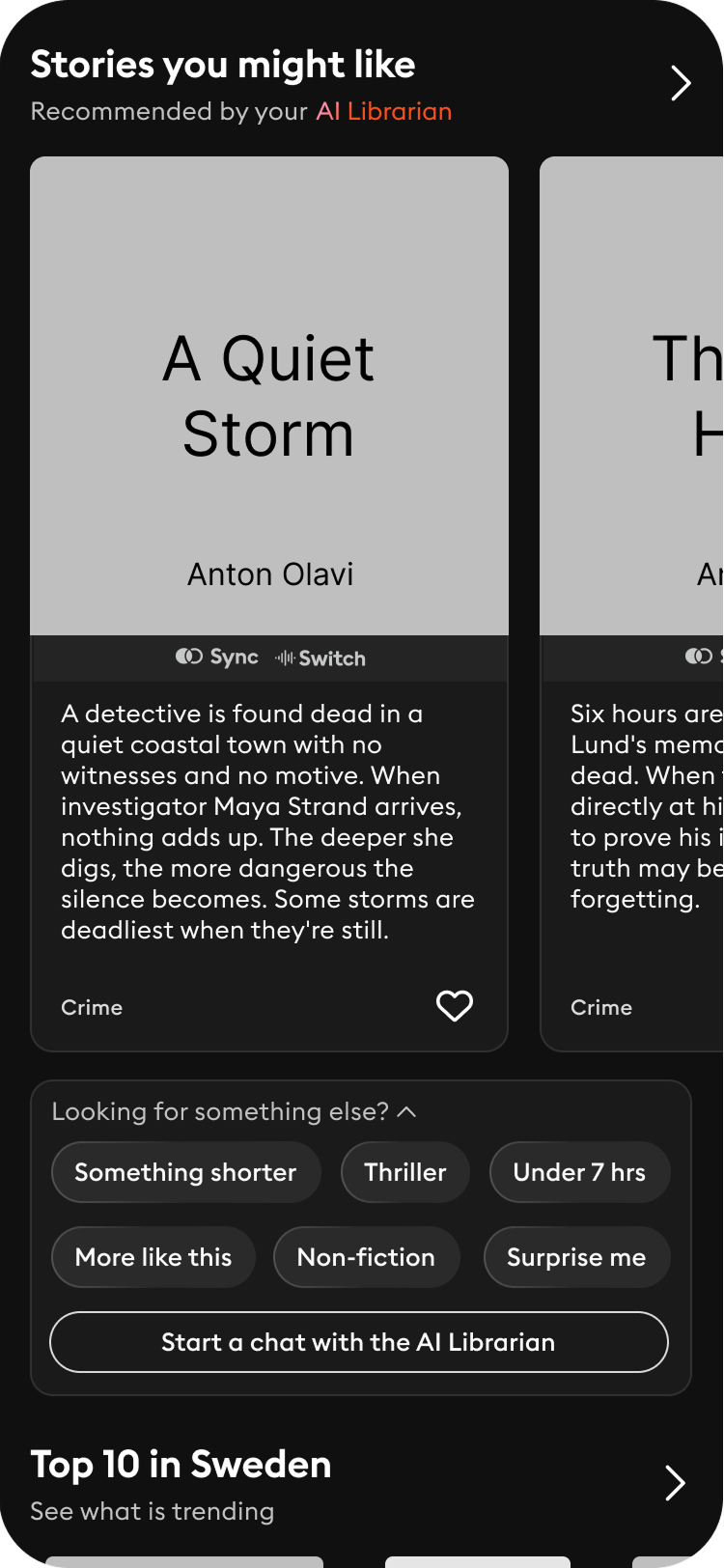
AI interfaces should offer a low-effort default experience while making deeper personalization and interaction modes accessible on demand.
Personal Context over System Categories
Based on Nielsen H2 — Match Between System and Real World
AI recommendation interfaces should surface the user's own listening behavior as visible reference points, using personal context rather than broad system-generated categories.
Reclaiming Agency from AI
Based on Nielsen H3 — User Control and Freedom
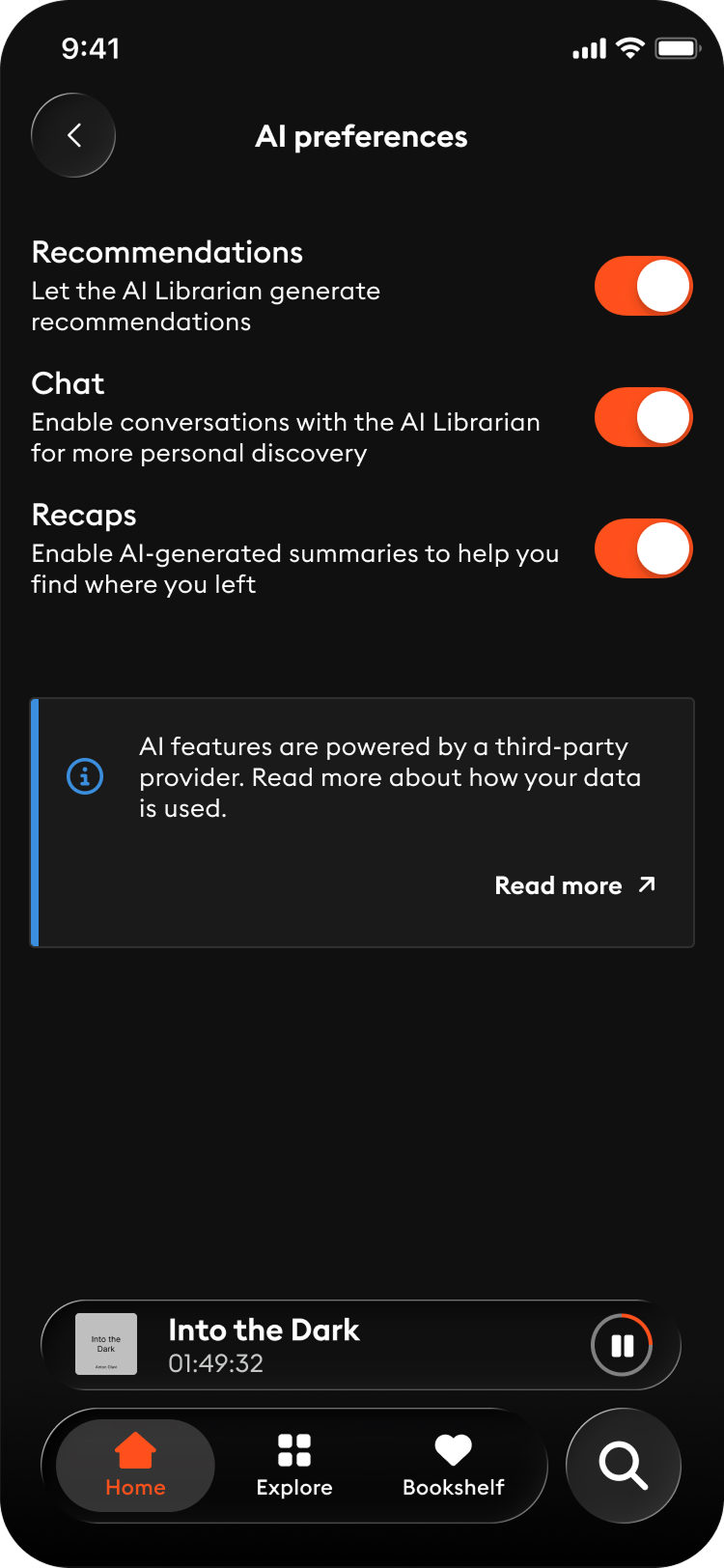
AI interfaces should provide visible and low-effort controls that allow users to reclaim agency. Whether by resetting AI memory, overriding recommendations, or switching to manual discovery.
Contextual and On-demand Transparency
Based on Nielsen H10 — Help and Documentation
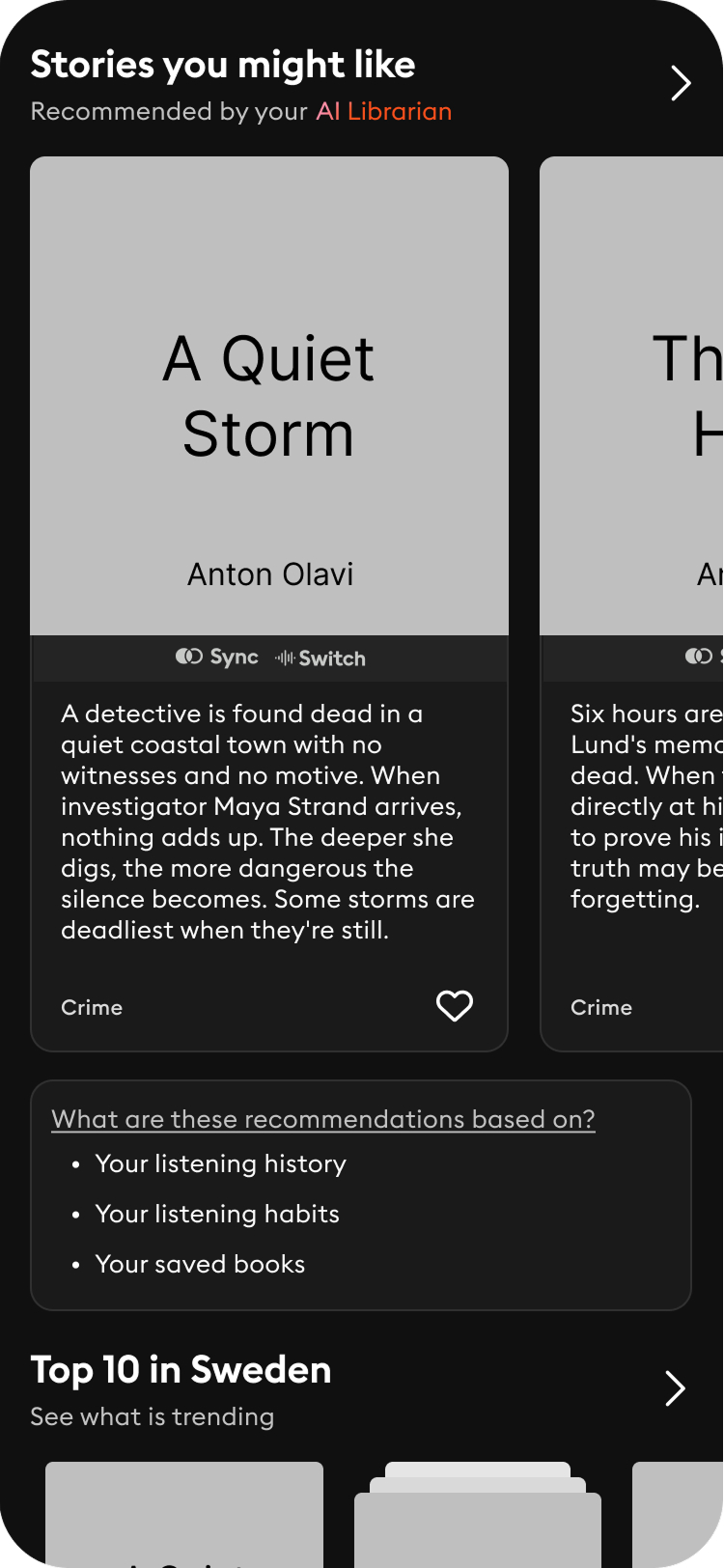
AI-related information should be designed as a secondary layer, accessible through contextual triggers such as expandable sections and in-context buttons placed at the exact point where the user encounters uncertainty.
THE PROTOTYPES
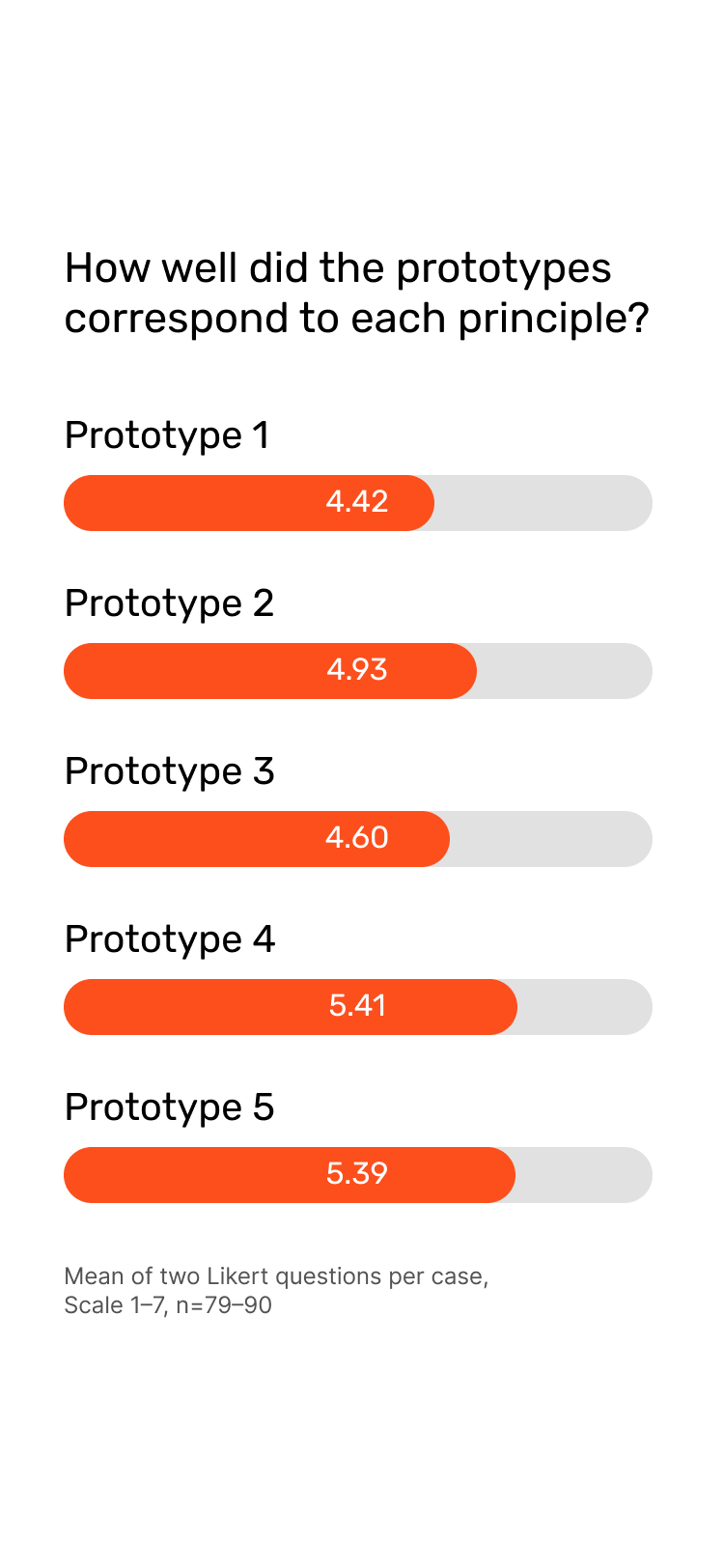
Each principle was implemented as a high-fidelity Figma prototype within Storytel’s existing design system, then evaluated by 97 real users.

 LIVE IN THE APP

OUTCOME
The study produced a grounded taxonomy of 224 codes, five empirically-derived UX/AI design principles, a formal OWL ontology, and five prototypes. All validated by Storytel users.
All survey scores fell above the neutral midpoint, suggesting the principles are grounded in real user needs while pointing toward future iteration and broader domain testing.
The fourth prototype has since been implemented and is now live in the Storytel app, reaching more than 2.7 million users.
Want to go deeper? The full thesis is available to read.
READ THE THESIS →